
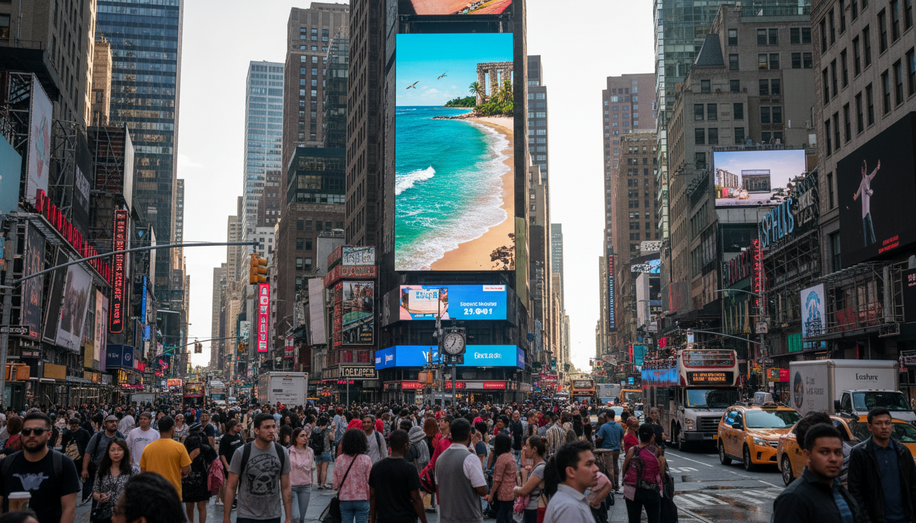

Digital out-of-home (DOOH) advertising stands at the forefront of a transformative era, propelled by rapid technological advancements and shifting consumer behaviors that demand more immersive, measurable, and interactive experiences. As screens proliferate in urban landscapes, transit hubs, and retail spaces, DOOH is not merely evolving but redefining how brands connect with audiences in real time, blending the tangible impact of physical presence with the precision of digital data. In 2024, these innovations are accelerating, with DOOH capturing over one-third of total out-of-home (OOH) spending in the US—projected to exceed $9 billion overall—while growing at rates outpacing traditional media.
Programmatic buying emerges as a cornerstone innovation, enabling automated, data-driven ad placements that mirror the efficiency of online programmatic ecosystems. By 2024, programmatic DOOH surpassed a quarter of all DOOH spend in the US, with forecasts pointing to over $1 billion by 2025, allowing advertisers to target audiences dynamically based on location, weather, or real-time events. This shift empowers campaigns to adapt instantaneously—swapping creatives for time-sensitive promotions like flash sales or election-day messaging—while integrating first-party data from retailers and mobile devices for hyper-local precision. Moving Walls highlights how this trend fuels performance-led spending, particularly for tactical activations, as measurement tools link DOOH exposures directly to sales lifts and digital conversions via QR codes and attribution partnerships.
Artificial intelligence (AI) and generative AI amplify this momentum, automating campaign planning and unleashing hyper-personalized content at scale. AI algorithms now analyze vast consumer datasets to predict audience movement, optimize formats, and even generate visuals tailored to passersby, making OOH more efficient and less intrusive than digital counterparts. Dentsu’s 2024 trend report underscores advanced data integration revolutionizing planning, while generative tools create audience movement models that pinpoint high-impact placements. Beyond planning, AI drives real-time creative refreshes, ensuring messages resonate amid fleeting attention spans in high-traffic zones.
Visual spectacles like 3D billboards and augmented reality (AR) overlays are captivating viewers, turning static displays into viral phenomena. Dimensional OOH, or 3D billboards, garners 72% consumer interest, with 55% likely to record and 58% to share on social media, elevating brands as premium and boosting purchase intent by 66%. Campaigns such as Maybelline’s oversized digital mascara wands in London’s metro went viral, inspiring imitators from Kylie Cosmetics to McDonald’s, and proving how faux OOH (FOOH)—CGI-enhanced simulations—synergizes with social amplification for exponential reach. These formats drive tangible actions: DOOH inspires online searches (44%), website visits (38%), and social engagement (30%), with digital transit ads influencing 43% of in-store purchases.
Retail media networks (RMNs) represent another seismic shift, fusing OOH with point-of-purchase influence through in-store screens and near-store placements. Leveraging rich first-party data, RMNs are projected to approach $1 billion by 2028, comprising nearly a quarter of DOOH spend, and blending awareness with conversions via QR codes and shopper insights. This omnichannel bridge positions OOH lower in the marketing funnel, guiding consumers from consideration to advocacy, as brands like those in transit hubs report 85% action rates from digital displays.
Sustainability and experiential marketing further shape the horizon, as consumers flock to in-person hotspots post-pandemic, craving authentic engagements over screen fatigue. OOH’s non-intrusive appeal yields the highest ad recall and 61% favorability, outperforming rivals, while eco-friendly LED screens and recyclable materials address environmental concerns. Traditional static formats, still two-thirds of spend, gain new life through digital boosts like QR integrations and influencer tie-ins, ensuring stability amid DOOH’s ascent.
Yet challenges persist: DOOH’s premium costs demand strategic high-impact locations, and robust measurement is essential to justify budgets. As 2024 unfolds, the fusion of AI, programmatic ecosystems, 3D visuals, RMNs, and data-driven agility positions digital OOH as indispensable for omnichannel dominance. Advertisers embracing these innovations will not only capture attention in the physical world but convert it into lasting loyalty, heralding a future where OOH transcends advertising to become a cultural force. With revenue hitting record highs and growth at 4.5-7.5%, the sector’s trajectory signals boundless potential.