
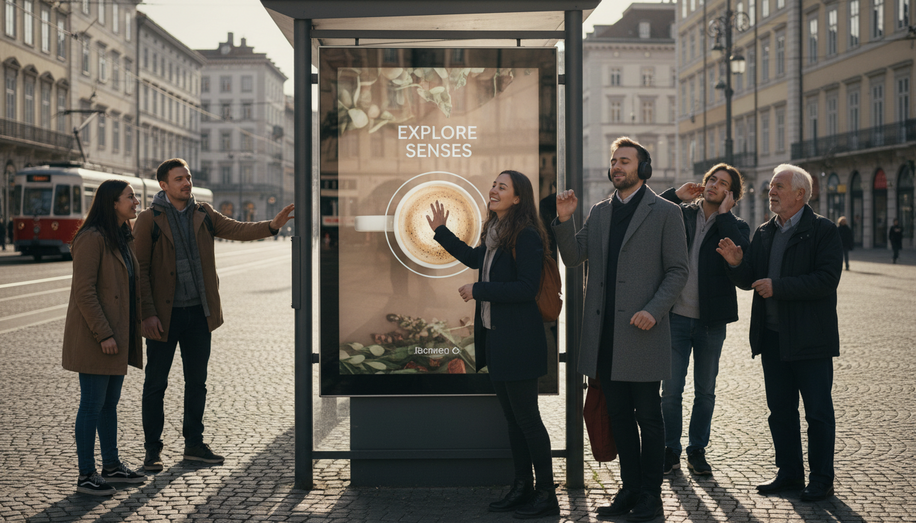

The advertising landscape has fundamentally shifted. With consumers bombarded by messaging across multiple channels, out-of-home advertising must now do more than simply catch the eye—it must engage the entire sensory experience. Multi-sensory out-of-home (OOH) campaigns represent a powerful evolution in how brands connect with audiences, transforming static displays into immersive moments that resonate far beyond the initial encounter.
Traditional billboards have long relied on visual appeal alone, but this approach struggles to break through the clutter of modern urban environments. Multi-sensory campaigns address this challenge by layering sound, scent, touch, and interactive elements into outdoor advertising, creating what researchers call “superadditivity”—where the combined effect exceeds the sum of individual sensory components. This principle has proven particularly valuable in OOH, a medium uniquely suited to engaging people in their everyday environments.
The effectiveness of multi-sensory advertising lies in its impact on human memory and emotion. Studies consistently show that engaging multiple senses significantly improves memory retention of brand messages. When a consumer experiences an advertisement through sight, sound, and touch simultaneously, that experience embeds itself more deeply in memory than visual stimulation alone. Beyond recall, multi-sensory experiences trigger stronger emotional responses, enabling brands to forge deeper connections with their audiences. This emotional dimension transforms advertising from a transactional message into a meaningful interaction.
Real-world examples demonstrate the tangible impact of this approach. Starbucks released coffee aromas from London bus shelters during morning rush hours, increasing dwell time by 25 percent and driving foot traffic to nearby stores. Nike’s talking billboards in New York featured audio storytelling with dynamic voiceovers synchronized to digital visuals, generating over 1.2 million social media impressions. Similarly, an Absolut Vodka campaign in Stockholm used touch-sensitive posters allowing passersby to mix virtual cocktails on-screen, resulting in a 40 percent increase in brand recall among participants. These campaigns succeeded not because of novelty alone, but because sensory engagement created memorable, shareable experiences.
The social media dimension cannot be understated. Multi-sensory billboards frequently become viral sensations as people capture and share these captivating experiences online, extending campaign reach far beyond the physical location. This organic amplification provides measurable value that extends the return on investment considerably. Interactive and multi-sensory experiences invite photographs, videos, and shares—effectively turning pedestrians into brand advocates.
From a measurement perspective, modern multi-sensory OOH campaigns benefit from advanced analytics. Motion sensors, eye-tracking technology, and connectivity data enable real-time feedback on consumer interaction. This data-driven approach allows brands to optimize content and placements based on empirical evidence of engagement, moving beyond assumptions to measurable results. According to advertising experts, multisensory activations often generate three to four times more audience interaction compared with standard digital or static boards.
Implementing effective multi-sensory campaigns requires strategic consideration. Location matters significantly—high-traffic areas in urban centers and entertainment hubs maximize engagement potential for interactive and three-dimensional displays. Additionally, sensory elements must enhance storytelling rather than distract from the core message. When thoughtfully integrated, these campaigns increase both foot traffic and social engagement.
The competitive advantage of multi-sensory OOH extends beyond immediate engagement metrics. By offering something unique and unexpected, brands differentiate themselves from competitors and create lasting impressions that inform purchase decisions. In an environment where attention is currency, multi-sensory experiences represent a sophisticated investment in brand communication.
As cities increasingly become canvases for immersive storytelling, the most effective outdoor campaigns are those that engage more than sight alone. The future of OOH belongs to brands willing to embrace the full spectrum of human sensory experience, transforming ordinary streets into destinations where consumers don’t simply see advertisements—they feel, hear, and remember them.